
I used to think keywords were simple. Just the words I type into a search box, right?
Then I started learning SEO, and suddenly there was a whole dictionary of terms: search intent, long-tail keywords, keyword research, keyword analysis. Every article explained it differently, and somehow I ended up more confused than when I started.
So I wrote this to clear things up — in plain English — and make the next steps easy to follow.
By the end, you’ll understand two things:
First, what keyword research actually is — and why it’s not as complicated as it sounds.
Second, why it‘s worth your time — because it directly decides whether anyone reads what you write.
📌 Reading Guide
This is Part 1 of the Keyword Research trilogy (concepts & fundamentals).
• Ready for the full workflow? Continue to: Step-by-Step Keyword Research Guide
• Want the AI-powered approach? Jump to: AI Keyword Research Tutorial
So, What Is Keyword Research? (And How Is It Different from a Keyword?)
Let’s clear up the confusion right away.
Keywords are the words people type into search engines. “How to fix a bike chain,” “best coffee shop near me,” “SEO tips for beginners” — these are all keywords. Simple.
Keyword research is a different animal.
The internet is full of definitions. Some call it “the process of discovering search queries.” Others say it’s “finding and analyzing search terms.” Strip away the jargon, though, and it all points to the same thing:
Keyword research isn‘t about individual words. It’s a set of actions: finding terms, filtering them, and understanding what the person behind the search actually wants.
Think of it like fishing. Keywords are your bait. Keyword research is the scouting trip — figuring out where the fish are, what they‘re hungry for, and when they’re biting.
One is the tool. The other is the strategy. They‘re not the same thing.

So what does the scouting trip look like?
Let’s break it down.
You find the terms your audience actually uses. Then you check whether people are actually searching for them. Next, you figure out what those searchers really want — an answer, a comparison, or a checkout page. Finally, you create a piece of content that delivers exactly that.
Find, filter, understand, create. That‘s keyword research.
Why Should You Even Care?
You might be thinking: “Okay, I get it. But do I actually need to learn this?”
Here’s the short answer: if you want people to find your writing, yes.
Creating content without keyword research is like setting up a lemonade stand on a dead-end street. You‘ve got the sign, the cups, the perfect recipe — but nobody walks by.

The same thing happens online.
You can write the most brilliant, well-researched article, but if nobody is searching for that topic, it’s invisible. According to Ahrefs, 90.63% of web pages get zero search traffic from Google. Not because the content is bad — but because it was built around topics nobody is looking for.
Keyword research answers one critical question: Is anyone actually searching for this?
It doesn‘t guarantee you’ll rank #1. But it does guarantee you‘re not shouting into the void.
“But can’t I just write about trending topics?”
Here‘s the problem: “trending” doesn‘t mean “winnable.” A brand-new site trying to rank for ultra-competitive keywords is like an amateur soccer team competing in the Premier League. Technically possible? Sure. Likely? Not even close.
Keyword research helps you find the sweet spot: topics people are searching for that you actually have a shot at ranking for. At the end of the day, it solves a very practical problem: your time and energy are limited. Spend them where they count.
What Kinds of Keywords Are There?
Now that you know what keyword research is — and why it matters — let‘s look at the types of keywords you’ll encounter.
The goal here isn‘t to memorize categories. It’s to build a reflex: when you see a search term, you immediately know whether it‘s worth pursuing and how to approach it.
There are two ways to slice keywords: by length and by intent.
By Length
Short-tail (head terms) — 1–2 words, e.g. “SEO,” “coffee,” “fitness.” High search volume, but the SERPs are packed with giants. New sites have almost no shot.
Medium-tail — 2–3 words, e.g. “SEO tips,” “best coffee maker.” More specific, but still tough to crack.
Long-tail — 4+ words, e.g. “how to do SEO as a beginner,” “best home espresso machine under $500.” Lower volume, but the intent is clear — and as Yoast puts it, the longer and more specific the keyword, the easier it is to rank.
For beginners, long-tail keywords are the only fight worth picking. This isn‘t settling — it’s strategy.
By Intent
Length tells you part of the story. Intent tells you the rest.
Google‘s #1 ranking factor isn’t how many times you use a keyword. It‘s whether your page satisfies what the searcher actually wants.
If someone types “how to fix a bike chain,” Google won‘t show them a page for “bike repair course enrollment.” That’s not what they need right now. They need someone to tell them which bolt to turn first.
That‘s why the most critical step in keyword research isn’t finding the words — it‘s figuring out what stage the searcher is in.
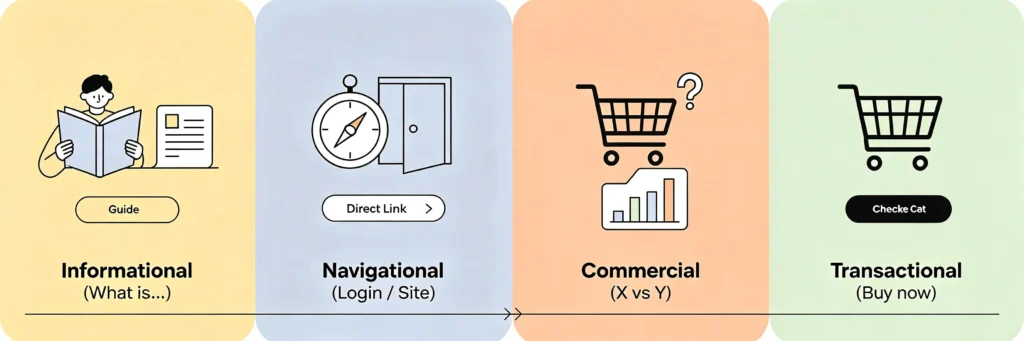
| Intent Type | What It Means | Example Query | What They Want |
|---|---|---|---|
| Informational | They want to learn | “what is keyword research” | A guide or explainer article |
| Navigational | They want a specific site | “Semrush login” | A direct link, not a tutorial |
| Commercial Investigation | They want to compare | “Ahrefs vs Semrush” | A comparison to help them decide |
| Transactional | They want to buy | “buy SEO tool” | A product page or purchase option |
These four intents require completely different types of pages. Write a transactional query as a blog post, and Google won‘t rank you — because that’s not what the user wanted.
What Are the Biggest Mistakes Beginners Make?
Knowing the types helps you spot the two traps almost every beginner falls into. Avoid these, and you‘re already ahead of the curve.
Mistake #1: Chasing the Highest Search Volume
This is the most common one.
Beginners open a keyword tool, sort by “search volume,” and target whatever sits at the top. Bigger numbers feel like bigger opportunities.
But high search volume comes with high competition. Search “SEO,” and you’ll see Ahrefs, Semrush, and HubSpot dominating the first page. Your new site isn‘t outranking them anytime soon.
More importantly, high volume doesn’t equal high conversion. Someone searching “what is CRM” and someone searching “best CRM for freelancers with invoicing” are in completely different mindsets. One is browsing. The other is ready to buy. A keyword with 100 monthly searches and clear buying intent often outperforms one with 10,000 searches and no direction.
Brian Dean of Backlinko once put it perfectly: “I‘d rather have 100 people who love my content than 10,000 who kinda like it.”
The takeaway: prioritize relevance over volume. If 100 people are searching a term and those 100 are exactly your target audience, that’s a great keyword.
Mistake #2: Treating Keyword Research as a One-Time Task
The other extreme: spending an entire afternoon building a massive keyword list, then burying it in a folder and never opening it again.
Keyword research isn‘t a checkbox. Search habits shift. Your competitors evolve. The keywords you could rank for six months ago might be saturated now.
Treat keyword research as a habit, not a document. Spend 30 minutes a week checking what new terms are popping up in your niche. Look at Google’s autocomplete, scan community threads, or just ask yourself: “What are my readers asking about right now that they weren‘t six months ago?” That’s enough to keep your keyword list fresh.
How Many Keywords Should You Target Per Article?
Almost every beginner asks this.
The answer is simpler than you think: one primary keyword per article.
Don‘t get greedy. Owning one term is a win.
“But does that mean I can only use one keyword?”
No. Your article will naturally touch on many related terms. But your goal is singular — signal to Google that this page is the definitive answer to one specific question. Other keywords can appear, but they’re supporting actors, not the lead.
What about secondary keywords? Two to three is plenty. Prioritize long-tail variations.
Long-tail keywords have lower competition and clearer intent, making them easier for beginners to rank for. Once your article gains traction on those terms, the primary keyword often follows. This is called “using long-tail to leverage the main term” — the safest playbook for new sites.
Let me show you how that looks in practice. Here‘s what I did for this very article:
| Role | Keyword | Where It Lives |
|---|---|---|
| Primary | “what is keyword research” | H1, introduction, conclusion |
| Secondary | “what is keyword research and analysis in SEO” | H2 section on the four steps |
| Secondary | “what is the relationship between keywords and research” | H2 section on keyword vs. research |
One primary + two long-tail secondaries. That’s the formula. Use it when you plan your own content.
One last thing: don‘t treat keywords like a checklist to cram into your draft. Write for the reader first. Make it genuinely useful. Then go back and check whether those terms appeared naturally. That order matters.
So, What Should You Actually Remember?
Let’s bring it all home.
Keyword research isn‘t complicated. You don’t need to be an expert to start. Just remember these four things:
First, keywords aren‘t technical concepts — they’re just questions your audience is asking. Behind every search query is a real person with a real question. That‘s your audience.
Second, keyword research is about figuring out what that person actually wants. Do they want to learn? Teach them. Do they want to buy? Show them. Do they want to go somewhere? Point the way. That’s the whole point.
Third, beginners should obsess over long-tail keywords and ignore head terms. Head terms are minefields packed with giants. Long-tail keywords are your ladder. Climb to page one with those first, then think about the next step.
Fourth, one article, one primary keyword. Add two or three long-tail secondaries, and that‘s all you need. Don’t overcomplicate it. Owning a single term already puts you ahead of most people.
Once all of this clicks, keyword research stops being intimidating. It becomes what it always was: a conversation between you and the person searching.
The rest is just doing the work.
Wait, What About GEO?
The article could end here, but you‘ve probably seen the term “GEO” floating around. Let’s spend a minute on it.
GEO stands for Generative Engine Optimization. In simple terms: making your content easy for AI search tools — like ChatGPT Search, Perplexity, or Microsoft Copilot — to cite. Instead of a list of blue links, these tools generate a direct answer and attach sources. If your site gets cited, you earn visibility inside that AI-generated response.
So, does keyword research still matter for GEO?
Absolutely.
AI doesn‘t cite content at random. It looks for pages that are clear, well-structured, and backed by reliable sources. In other words, it favors the exact kind of content that solid keyword research helps you create.
You don’t need a new playbook for GEO. Just keep doing what you‘re doing — clearly, naturally, and with the reader in mind. That’s what both Google and AI reward.
FAQ
What is keyword research in SEO?
Keyword research is the process of finding words people type into search engines, determining what they actually want, and using that insight to create content that ranks. It’s not just about finding terms—it’s about understanding the person behind the query.
Why is keyword research important for beginners?
Without keyword research you risk writing about topics no one searches for. It shows you which terms have demand, which ones you can realistically compete for, and how to attract the right visitors who are ready to engage with your content.
How do I do keyword research with no experience?
Start by listing 5‑10 broad topics in your niche. Use a free tool like Google Search Console or Ahrefs’ free keyword generator to see what people actually search. Focus on long‑tail keywords with low competition and clear intent—they’re easier to rank as a new site.
What are long‑tail keywords and why should I target them?
Long‑tail keywords are specific, multi‑word phrases (4+ words) like “how to make cold brew coffee at home.” They have lower search volume but much clearer intent, less competition, and higher conversion rates—making them perfect for beginner websites.
How many keywords should one article target?
Aim for one primary keyword and 2‑3 closely related long‑tail secondary keywords. Keeping the focus tight helps Google understand exactly what your page is about, while the secondary terms allow you to naturally cover related subtopics.
References
📚 SEO Cognitive Series
- • Part 1: How Google Search Works – Crawling, indexing, ranking explained.
- • Part 2: Content Quality & Authority – E‑E‑A‑T, search intent, backlinks, UX.

About Shelldy
An ordinary practitioner learning SEO from scratch. By day, I work in the internet industry; by night, I turn what I’ve learned into articles. I believe that honest learning records are more valuable than rehashed tips. Feel free to connect and exchange ideas.
Pingback: AI Keyword Research Made Easy: 4 Simple Steps for Beginners
Pingback: Step-by-Step Keyword Research Guide for Beginners (2026) | WhizSEO
Pingback: WordPress SEO Checklist: Start with Google Search Console
Pingback: How to Improve SEO Score on WordPress: Complete 72-94 Guide