
Many people think SEO starts with “writing articles.” But they skip the most important first step — research.
This is how to do keyword research for your blog. Think of it like building a house: you wouldn’t start laying bricks without a blueprint.
Yet too many bloggers start writing without knowing what their audience is actually searching for.
Keyword research is that blueprint. It answers one fundamental question: “What are my potential readers typing into search engines (and AI chatbots) right now?”

Get this right, and everything else — content creation, technical optimization, link building — becomes easier. Get it wrong, and you’re writing in the dark.
According to Ahrefs, 90.63% of all web pages get zero organic traffic from Google. The primary reason? They either target keywords nobody searches for, or they compete against giants with no realistic chance.
💡 Key Insight: Keyword research isn’t about finding the most popular terms; it’s about matching real user needs to content you can actually rank for. Done right, your content gets found. Done wrong, you’re just publishing into the void.
📌 Reading Guide
This is Part 2 of the Keyword Research trilogy (the complete workflow).
• New to keyword research? Start here: What Is Keyword Research?
• Want the AI-powered approach? Jump to: AI Keyword Research Tutorial
In this article, we’ll cover:
Part 1: What Is Keyword Research? (And Why It Matters More in 2026)
1.1 Definition
Keyword research is the process of identifying and analyzing the search terms your target audience types into search engines and large language models (LLMs) like ChatGPT, Claude, and Gemini.
The goal is to determine which terms are worth targeting based on factors like search volume, competition, and — most importantly — the intent behind a user’s query.
In simpler terms: keyword research is translating “what users are thinking” into “what your content should be about.”
1.2 Why Keyword Research Is the Foundation of SEO
- Without keyword research, you’re guessing. You might write a brilliant article that nobody searches for.
- With keyword research, you know exactly what your audience wants — and you give it to them.
Keyword research helps you:
- Understand user needs — what problems are they trying to solve?
- Find competitive gaps — where can a small blog actually win?
- Guide content creation — what to write, in what format, and for whom.
As one industry expert put it: “The strongest keyword lists aren’t the largest; they’re filtered by intent, ensuring every click has a clear purpose.”
1.3 Two Common Misconceptions
Misconception #1: “I should only target high-volume keywords.”
High-volume keywords (like “SEO”) are incredibly competitive. Big brands with massive budgets dominate them. For a personal blog, this is a losing battle.
Misconception #2: “Keyword density is what matters.”
Keyword density — the percentage of times a keyword appears in your content — is a relic of the past. In 2026, intent and relevance matter far more than repetition.
Part 2: The Three Types of Keywords You Need to Know
2.1 By Length: Head Terms vs. Long-Tail Keywords
| Type | Length | Search Volume | Competition | Conversion Rate | Best For |
|---|---|---|---|---|---|
| Head Terms | 1–2 words (e.g., “SEO”) | High | Extreme | Low | Big brands |
| Middle Terms | 2–3 words (e.g., “SEO tutorial”) | Medium | Medium-High | Medium | Established sites |
| Long-Tail Keywords | 3+ words (e.g., “how to do keyword research for beginners”) | Low | Low | High | Personal blogs |
🔑 Why long‑tail keywords are a goldmine for personal blogs:
Long‑tail keywords have lower individual search volumes, but they collectively make up over 70% of all searches. More importantly, they reflect users who know exactly what they want — which means higher conversion rates.
For a new blog: start with long‑tail, work your way up.
Data shows that pages optimised for long‑tail keywords move up nearly twice as fast as those targeting short‑head terms.
2.2 By Intent: The Four Types of Search Intent
We covered search intent in detail in SEO Cognitive Series (Part 2): Content Quality & Authority. Here’s a quick refresher:
| Intent Type | Example Query | What the User Wants | Your Content Should Be |
|---|---|---|---|
| Informational | “how to fix a leaky faucet” | A step-by-step guide or explanation | Tutorial, guide, how-to article |
| Navigational | “Facebook login” | Go to a specific website/page | Brand or product page |
| Transactional | “buy Nike Air Max” | A product page with a “buy” button | Product page, pricing page |
| Commercial Investigation | “best DSLR camera 2026” | Comparisons, reviews, pros/cons | Comparison post, review, buyer’s guide |
📌 Golden Rule: Your content type must match the user’s search intent. Do not write a sales page for someone who just wants to learn.
Real‑world example: Search “best SEO tools.” The top results are comparison articles with tables. If you write a single‑product review, you’re not matching intent — and you won’t rank, no matter how good your content is.
Part 3: How GEO Is Changing Keyword Research
Before we dive into the step-by-step process, we need to talk about GEO — Generative Engine Optimization.
3.1 What Is GEO?
GEO is the practice of optimizing content to be cited, summarized, and recommended by AI-powered search engines like ChatGPT, Perplexity, Google AI Overviews, and Claude.
Unlike traditional SEO, which aims to rank a page among a list of search results, GEO aims to get your brand mentioned in an AI-generated answer.
3.2 What This Means for Keyword Research
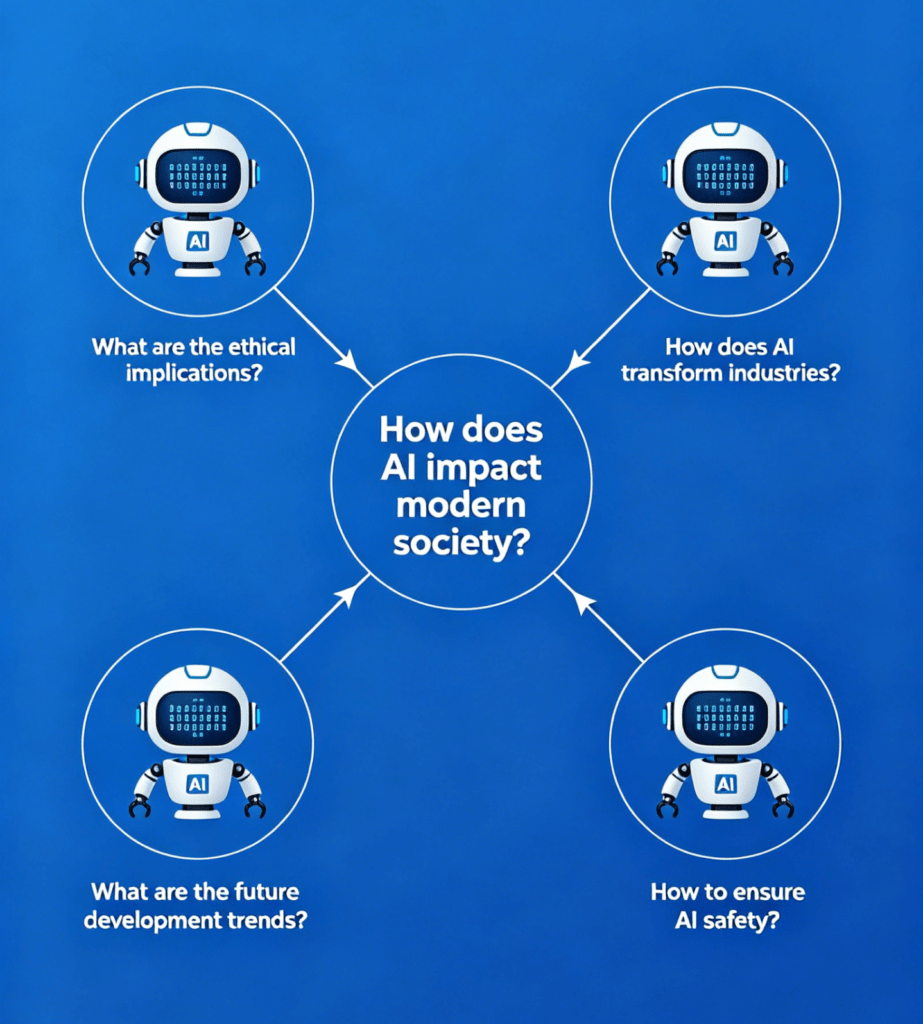
First, the good news: Google itself confirmed that “optimising for generative AI search is optimising for the search experience, and thus still SEO.” The fundamentals haven’t been thrown out.
But keyword research is evolving in three important ways:
① Query Fan‑Out Is the New Keyword Mindset
Traditional SEO assumed a one‑to‑one relationship: one keyword → one SERP → one page. AI‑powered search uses query fan‑out — your initial keywords are used to “fetch additional relevant search results,” and those are combined into an answer.
Google’s own example: a search for “how to fix a lawn that’s full of weeds” fans out into “best herbicides for lawns,” “remove weeds without chemicals,” and “how to prevent weeds in lawn.”
💡 What this means for you: Instead of optimising for a single keyword, you need to think in clusters of related questions. Your content should answer not just one query, but the half‑dozen related queries a user might ask next.
② Entities Matter More Than Exact‑Match Keywords
AI engines don’t just look for keywords. They look for entities — concepts that the machine understands as distinct objects with specific properties and relationships.
An entity is a “thing” with an identity: a brand, a person, a product, a concept. Keywords are strings of characters. Entities are the things those strings refer to.
Research from Princeton and IIT Delhi found that entity‑rich, fact‑dense content can improve AI citation visibility by up to 40%.
💡 What this means for you: When researching keywords, also ask: “What entities are associated with this topic? How can I clearly define my brand as an entity?”
③ AI Users Search Differently
The average ChatGPT prompt is around 60 words, compared to just 3.4 words for a typical Google search. AI users are more conversational, more specific, and more likely to act on what they’re told.
💡 What this means for you: Your keyword research should include conversational, question‑based phrases — the kind of language people use when talking to an AI, not just typing into a search bar.
3.3 The Bottom Line on GEO and Keyword Research
Keyword research isn’t dead — it’s just evolving. The fundamentals (understanding your audience, matching intent, creating quality content) still apply. But now you need to think bigger:
- From one keyword → to clusters of related questions
- From keyword strings → to entities and relationships
- From search queries → to conversational prompts
Part 4: The Six-Step Keyword Research Process
Now let’s get practical. Here’s a six-step process you can follow to find and prioritize the right keywords for your blog.
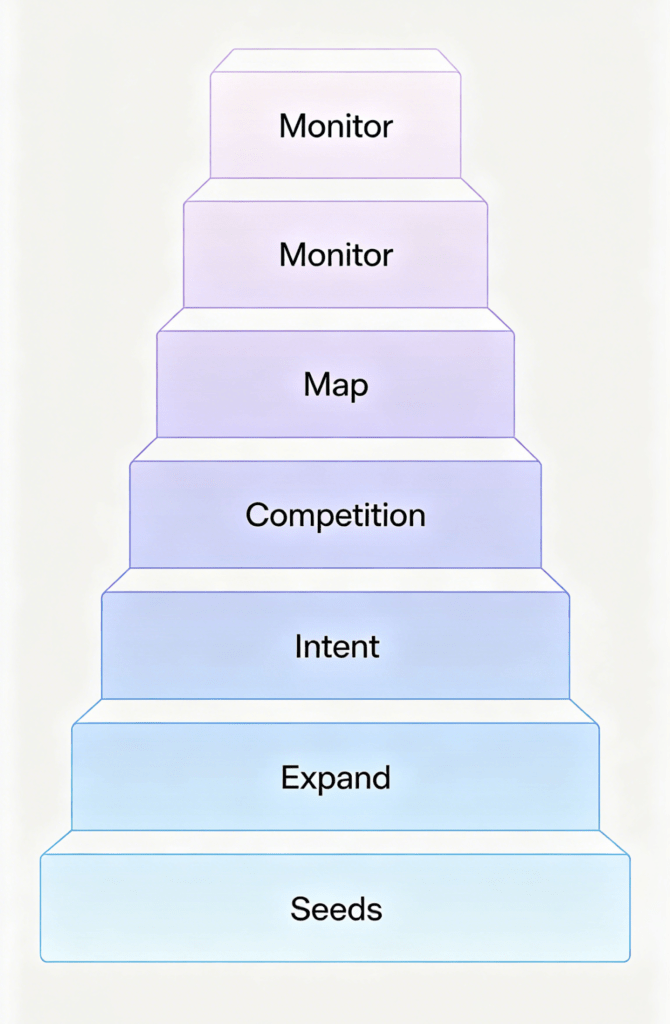
Step 1: Define Your Core Topic (Niche) and Seed Keywords
What to do: Start with your blog’s core topic. What is your website about? Who is it for?
Then, list 5–10 “seed keywords” — the foundational terms that describe your niche.
Example (for this blog, whizseo.com):
- SEO
- GEO (Generative Engine Optimization)
- AI search
- SEO for beginners
- Keyword research
- Content optimization
💡 GEO tip: Also think about the entities in your niche. For whizseo.com, entities might include: “SEO,” “GEO,” “Google,” “ChatGPT,” “Perplexity,” “AI search.” Start defining these clearly.
Step 2: Expand Your Keyword List Using Tools
What to do: Plug your seed keywords into keyword research tools to generate hundreds (or thousands) of related suggestions.
Key metrics to look at:
- Search Volume — How many people search this per month?
- Keyword Difficulty (KD) — How hard is it to rank for this term?
- Intent — What does the user actually want?
💡 Pro tip for beginners: Don’t get overwhelmed by the number of suggestions. Start with 20–30 promising keywords and go deep on those.
Step 3: Analyse Search Intent (The Most Important Step)
What to do: For each keyword on your shortlist, search it in Google and see what kind of results show up.
Ask yourself:
- Are the top results blog posts? Product pages? Videos? Guides?
- What format is Google rewarding? (Listicles? Step‑by‑step? Comparison tables?)
- Does your planned content match what’s already working?
⚠️ Rule: If your content type doesn’t match the search intent, you won’t rank — no matter how good your content is.
Example: Search “best SEO tools.” The top results are comparison articles with tables. If you write a single‑product review, you’re not matching intent.
Step 4: Evaluate Competition and Identify Opportunities
What to do: Assess whether you can realistically rank for each keyword.
For beginners, use this filter:
- Search volume: 100–1,000 per month (don’t chase the 10,000+ terms yet)
- Keyword Difficulty: KD < 30 (on a 0–100 scale)
- Intent: Clear and specific (not vague)
A simple reality check: Look at the first page of Google results for your keyword. Are the top results from massive authority sites (Wikipedia, Forbes, big brands)? If yes, that keyword is probably too competitive for a new blog.
Look for gaps: Are there keywords where the top results are outdated, thin, or not fully answering the question? Those are opportunities.
💡 Real‑world experience: I once helped a B2B industrial client whose product pages had detailed content and good keyword coverage, but they never got past page three. Why? The entire site lacked a single real name, office photo, or client case study. That’s a classic EEAT gap. After we added a proper “About Us” page, team introductions, and real case studies, rankings started to climb steadily.
Step 5: Map Keywords to Content (Keyword‑to‑Content Mapping)
What to do: Assign each keyword to a specific piece of content — and plan the content structure around it.
For each keyword, define:
- Target page: Which URL will cover this keyword?
- Primary keyword: The main term for this page (1 per page)
- Secondary keywords: 2–4 related terms to include naturally
- Content format: Blog post, guide, comparison, video, etc.
- H2/H3 structure: Outline the sections before you write
Example mapping:
| Keyword | Target Page | Primary | Secondary | Format |
|---|---|---|---|---|
| “how to do keyword research” | /keyword-research-guide/ | how to do keyword research | keyword research for beginners, SEO keyword strategy | Step‑by‑step guide |
| “best keyword research tools” | /keyword-research-tools/ | best keyword research tools | free keyword tools, Ahrefs vs Semrush | Comparison |
💡 GEO tip: When mapping keywords, also map related questions. For “how to do keyword research,” related questions might include: “What is keyword research?” “Why is keyword research important?” “What tools do I need?” Cover these in your content to capture query fan‑out.
Step 6: Monitor, Measure, and Iterate
What to do: Keyword research is not a one‑time task. It’s a continuous cycle.
Use Google Search Console to:
- See which keywords are already bringing traffic to your site
- Find new keyword opportunities you hadn’t considered
- Identify which pages are underperforming and need optimisation
Review and update your keyword list every 1–3 months. Search trends change, your audience evolves, and new opportunities emerge.
Part 5: Keyword Research Tools — Free and Paid
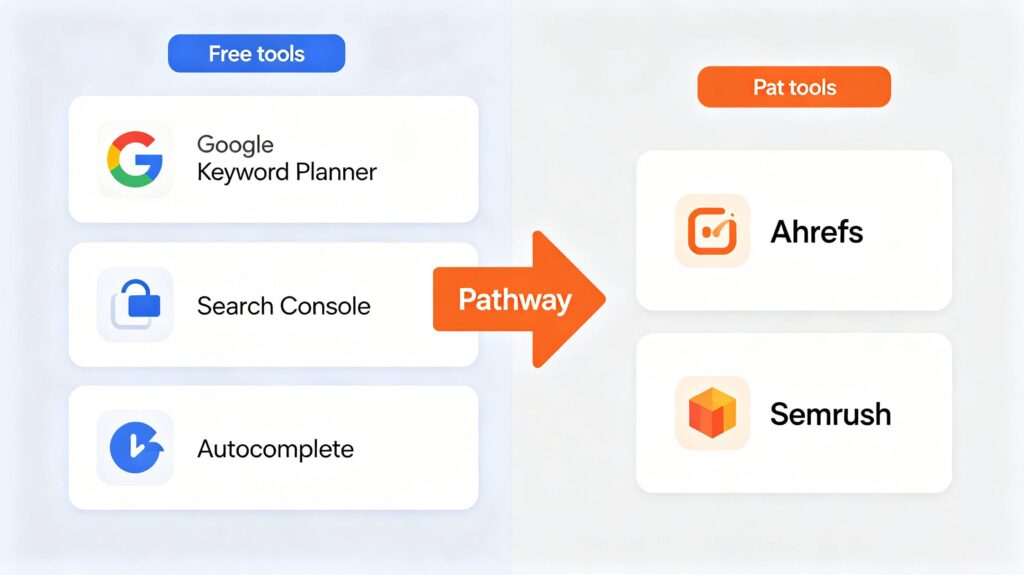
Free Tools
| Tool | Best For | Notes |
|---|---|---|
| Google Keyword Planner | Getting search volume data directly from Google | Most reliable data source; requires a Google Ads account |
| Google Search Console | Seeing which keywords already bring traffic to YOUR site | Free, accurate, and the data is yours |
| Google Autocomplete & Related Searches | Finding real long‑tail keywords users are searching | Zero cost, reflects actual user behaviour |
| Ubersuggest (free tier) | Keyword expansion and difficulty estimates | 3 searches per day without an account |
| AnswerThePublic | Finding question‑based keywords | Free for 3 queries per day |
Start here: Google Keyword Planner + Search Console + Autocomplete is enough to write your first 20 articles. Don’t feel pressured to pay for tools right away.
Paid Tools (When You’re Ready to Level Up)
| Tool | Best For | Pricing |
|---|---|---|
| Ahrefs | Comprehensive keyword research + competitor analysis | Free tier + Premium |
| Semrush | All‑in‑one SEO platform | Free tier + Premium |
| Moz Pro | Keyword research + rank tracking | Free tier (10 queries/month) |
Part 6: Where to Place Keywords (Once You’ve Found Them)
Finding keywords is only half the battle. You also need to place them where they matter most.
Critical Locations
- Title Tag — Include your primary keyword near the beginning.
- URL Slug — Use the primary keyword (keep it short and clean).
- H1 Heading — Naturally include the primary keyword.
- First 100 Words — Mention the primary keyword early in the body.
- H2/H3 Subheadings — Distribute secondary keywords naturally.
- Image Alt Text — Describe the image and include relevant keywords.
- Meta Description — Include the primary keyword (entices clicks).
Golden Rules for 2026
- Don’t stuff. Keywords should appear naturally where they belong. If it sounds forced, remove it.
- One primary keyword per page. Don’t try to target multiple unrelated topics in one article.
- Write for humans first, search engines second. This has always been true — and it still is.
💡 GEO tip: In addition to placing keywords, structure your content to answer questions directly. AI engines love clear, declarative answers that can be pulled into generated responses.
Summary: Key Takeaways
- Keyword research is the blueprint for everything else in SEO. Skip it, and you’re guessing.
- Long‑tail keywords are your best friend as a new blogger — lower competition, higher intent.
- Search intent matters more than search volume. Match your content to what the user actually wants.
- GEO is changing the game: think in query clusters, optimise for entities, and include conversational phrases.
- Follow the six‑step process: define seeds → expand → analyse intent → evaluate competition → map to content → monitor and iterate.
- Start with free tools (Google Keyword Planner, Search Console, Autocomplete). Upgrade to paid tools when you’re ready.
- Place keywords in critical locations — but always write for humans first.
Next up in the Research series: Competitor Keyword Analysis — finding what’s working for others and adapting it for your blog.
This article was updated in June 2026 to reflect the latest SEO and GEO best practices. All data and insights are based on current industry research and real‑world experience.
📚 SEO Cognitive Series
- • Part 1: How Google Search Works – Crawling, indexing, ranking explained.
- • Part 2: Content Quality & Authority – E‑E‑A‑T, search intent, backlinks, UX.

About Shelldy
An ordinary practitioner learning SEO from scratch. By day, I work in the internet industry; by night, I turn what I’ve learned into articles. I believe that honest learning records are more valuable than rehashed tips. Feel free to connect and exchange ideas.
Pingback: How to Use AI for SEO: A Beginner’s 8‑Step Guide
Pingback: What Is Keyword Research? A Clear Beginner's Guide (Part 1)
Pingback: AI Keyword Research Made Easy: 4 Simple Steps for Beginners
Pingback: WordPress SEO Checklist: Start with Google Search Console